Initial Attack Assessment (IAA)
Initial Attack Assessment
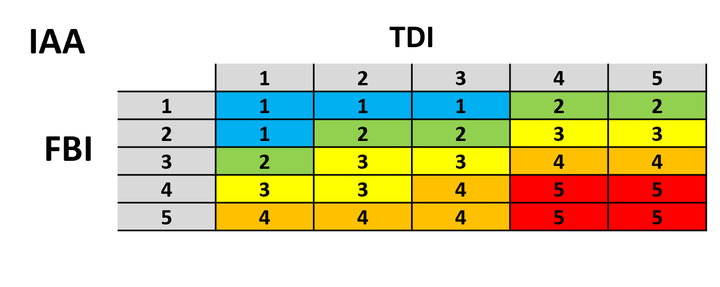
In addition to the fire behavior outputs, an Initial Attack Assessment Index (IAA) output is calculated for each fire spread prediction. Initial Attack are the actions taken by the first resources to arrive at a wildfire incident. Initial actions may be size up, patrolling, monitoring, holding action, or aggressive Initial Attack (NWCG, 2014).
The IAA model provides an estimation of the difficulty of fire control in the first 1-2 hours after the ignition time. It is a qualitative index ranging from 1 (low difficulty) to 5 (extreme). Although IAA gives a quick approximation of the suppression difficulty of each single fire, note that the index is not valid for longer fire durations than 2 hours (i.e., when the fire is not contained in the initial attack). This index is not recommended to estimate suppression difficulty in an Extended Attack Assessment (EAA).
Initial Attack Assessment (FireSim) | ||
Dataset | Values | Description |
IAA index | 1-5 | Index that evaluates the difficulty of the incident considering the 1st hour of spread. This index combines the Fire Behavior Index and Terrain Difficulty Index. |
Fire Behavior Index | 1-5 | Sub-index that summarizes the Rate of Spread and Flame length of the first hour of fire spread following the Fire Behavior Hauling chart categories. |
Terrain Difficulty Index | 1-5 | Sub-index that summarizes the operational implications of accessing the fire. |
The IAA index is compound of two sub-indices as follows:
Initial Attack Assessment Index = f(Fire behavior Index, Terrain Difficulty Index)
A description of the sub-indices is provided.
1h-Fire Behavior Index (FBI)
The 1h-FBI calculates the fire characteristics if burning without suppression during the first hour since ignition. It is calculated based on the Rate of Spread of the fire in chains per hour (80 ch/hr = 1 mi/hr), and Flame Length in ft. These values have a direct relation to suppression activities, as the commonly use Hauling Chart summarizes.
Fire Behavior Class | Rate of Spread (ch/hr) | Flame Length (ft) | Tactical Interpretation |
Very Low | 0-2 | 0-1 | Direct, Hand |
Low | 2-5 | 1-4 | Direct, Hand |
Moderate | 5-20 | 4-8 | Direct, Equip |
High | 20-50 | 8-12 | Indirect |
Very High | 50-150 | 12-25 | Indirect |
Extreme | 150+ | 25+ | Indirect |
FireSim uses the following matrix to calculate FBI ranging from 1 to 5 based on the aforementioned variables and ranges.
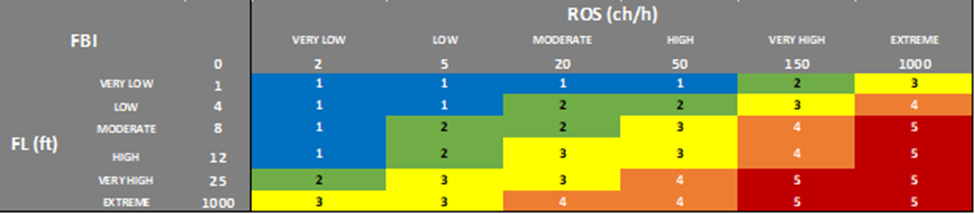
The different values of FBI vary from 1 (Low) to 5 (Extreme) as shown in the next table.
FBI Class | Description | |
1 | LOW | Fire will burn and will spread however it presents very little resistance to control and direct attack with firefighters is possible |
2 | MODERATE | Fire spreads rapidly presenting moderate resistance to control but can be countered with direct attack by firefighters |
3 | ACTIVE | Fire spreads very rapidly presenting substantial resistance to control. Direct attack with firefighters must be supplemented with equipment and/or air support. |
4 | VERY ACTIVE | Fire spreads very rapidly presenting extreme resistance to control. Indirect attack may be effective. Safety of firefighters in the area becomes a concern |
5 | EXTREME | Fire spreads very rapidly presenting extreme resistance to control. Any form of attack will probably not be effective. Safety of firefighters in the area is of critical concern. |